
Managing the Silence
Why Your Strongest Employees Are Your Biggest Burnout Risks

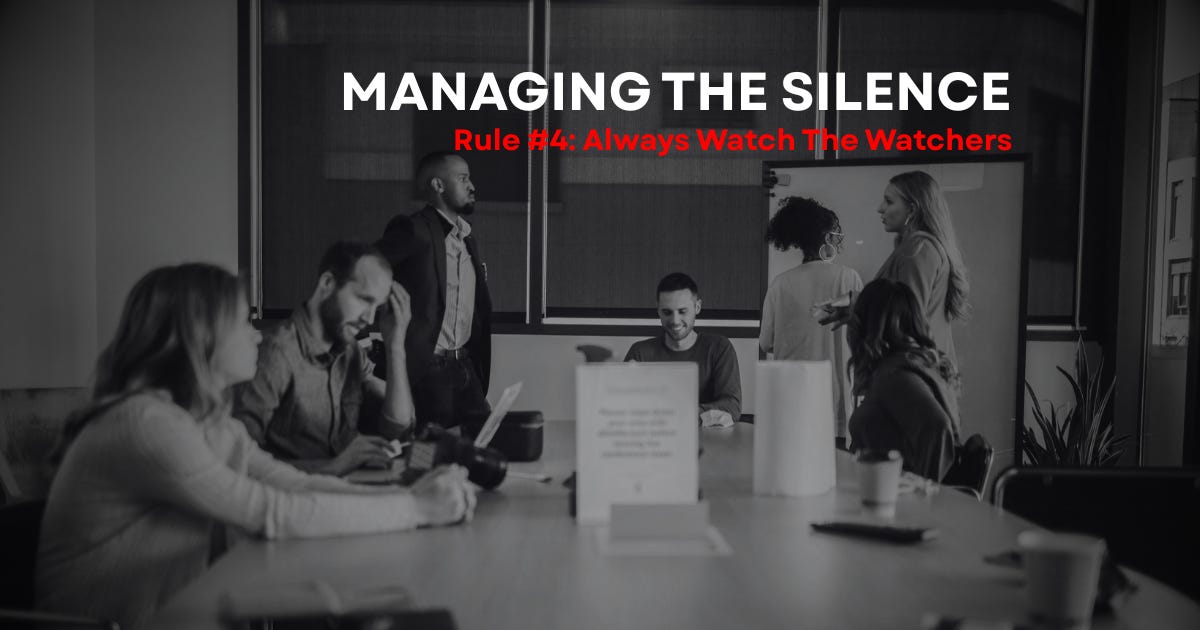
When chaos erupts in an organization, human nature dictates that we look directly at the center of the action. We stare at the immediate emergency—the product launch failure, the public relations crisis, or the missed quarterly target.
The dumpster fire, if you will.
But as a leader, your most important job isn’t managing the obvious. Your most important job is looking everywhere else.
In my 25-year career in law enforcement, this concept wasn’t just a vague management theory; it was a core operational directive: Always watch the watchers.
Tactically, this meant fighting the urge to lock eyes on the primary incident. While the public’s natural reaction to a crisis is to pull out their phones and stare, a trained commander consciously pulls some of their focus away from the commotion to read the broader environment. You know what the ‘baseline of normal behavior’ is, so you are looking for the anomaly—the person hanging back, quietly absorbing the impact, or looking where no one else is.
As I began to transition into strategic consulting and advisory work, I quickly realized that this principle of leadership is entirely universal. Every single corporation, non-profit, and executive team has its own version of “watchers”. They are your high performers, your ultra-reliable project managers, and the dependable directors who absorb massive amounts of organizational stress to keep the team moving forward when things go sideways.
Because they are so incredibly capable, executive leadership almost universally makes a dangerous assumption: They assume they are fine.
And, we all know what happens when you assume, right?
The reality is that silence is not always a sign of stability. Sometimes, it is the loudest indicator of impending burnout.
🛑 The Trap of the Self-Sustaining Asset
In high-stress fields, the individuals tasked with managing everyone else’s worst days are almost always the absolute last to raise their hands and ask for help. They process heavy organizational burdens, structural friction, and the relentless weight of expectations in total silence.
In the corporate world, this manifests as a toxic cycle:
· The Curse of the Competent: Your top 10% of performers get handed the messiest, highest-stakes projects because “they always deliver.”
· The Illusion of Autonomy: Because they don’t complain and rarely ask for resources, executives stop checking in on them to focus on lower-performing “problem children.”
· The Sudden Exit: One day, your most reliable manager walks into your office and hands in their resignation. There was no big explosion or dramatic warning sign—they simply ran out of fuel in total isolation.
When you lose a high performer, you don’t just lose a worker; you lose an organizational shock absorber. When they leave, the stress they were quietly absorbing suddenly fractures the rest of the team.
How do I know this? Because for a long time, I was that person.
🛠️ How to “Watch the Watchers”
If you want to build a truly resilient team and protect your organization’s most valuable human equity, you have to actively manage the silence. Here is how you can implement a tactical pause to audit your high performers:
1. Audit the Weight, Not Just the Output
Stop measuring an employee’s well-being solely by their green checkmarks on a project board. Look at the weight of what they are carrying. Are they consistently rescuing derailed projects? Are they the single point of failure for a critical division? If the board says they are thriving but their scope is continuously expanding without structural support, they are in the burnout red zone.
Ask yourself: “Why is it that Julia is involved in every project somehow?”
2. Conduct “Stay Interviews”
Don’t wait for an exit interview to discover why a high performer is exhausted. Schedule intentional, dedicated one-on-one time that has absolutely nothing to do with active status updates. Ask direct questions:
· What is a roadblock you are currently facing that you haven’t told me about because you’re used to fixing it yourself?
· If you could hand off one repeatable part of your current workload tomorrow to protect your bandwidth, what would it be?
How I practiced this: I began doing this after as many meetings as I could. I would choose someone that I hadn’t spoken with for a time and have them stay after for 2–3 minutes. Just to check on them.
3. Reward with Boundaries, Not Just Bonuses
When a team member pulls off a massive win or steers a crisis to safety, financial compensation is essential—but time and space are critical. Force your high performers to take a “tactical pause.” Actively protect their calendar for a week, block them from non-essential meetings, and model the behavior by refusing to send them non-emergency communications during their off-hours.
If you can do this before they bring it up, you are showing how much you are paying attention and care about their well-being.
🎯 Lead the Calm, Manage the Silence
Whether you are commanding a federal division or steering a corporate enterprise through a complex quarter, elite leadership requires 360-degree situational awareness.
Don’t wait for your strongest assets to break before you notice the strain. C
heck on your highest performers. Check on the ones who never complain and always handle the chaos with a smile.
Your integrity as a leader is defined by how fiercely you protect the people who protect your mission.
Join the Conversation: How do you intentionally check the pulse of your highest performers to ensure they aren’t carrying the weight of the team in silence? Let’s discuss in the comments below.